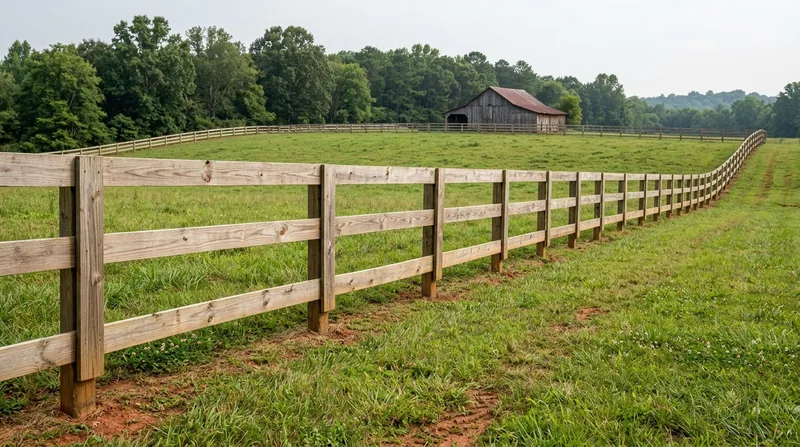




The rolling Piedmont terrain around Winston-Salem, Kernersville, Clemmons and Lewisville demands farm fence installation built to last through red clay winters, summer thunderstorms and the weight of livestock and equipment. Acreage owners across Forsyth, Davie, Yadkin and Stokes counties rely on split rail, no-climb horse fence, board fencing and field wire to define property lines, contain animals and manage access across uneven ground. We set posts firm in concrete, brace corners against slope and wind, and run straight lines over rolling hills where erosion and frost heave work year-round to undermine cheaper work. This guide explains what ranch fence installation costs, how we build it to hold, and what to expect when hiring a local contractor.
Why Farm & Ranch Fencing Matters in Winston-Salem's Piedmont Landscape
The Piedmont terrain here is unforgiving on fences. Heavy red clay holds water after storms, frost heaves posts in winter, and the tall oaks, tulip poplars and loblolly pines that shade our rolling hills drop limbs and whole trees across fence lines when ice storms and summer thunderstorms hit. Acreage fencing has to absorb that punishment without failing. A fence set shallow in tamped clay or built with undersized posts will sag, lean and eventually collapse under the combined weight of weather, livestock and equipment traffic. Split rail and board fencing also face the slow rot that moisture at the ground line brings to untreated wood in our humid summers. Ranch fencing done right means:
- Posts set deep in concrete footings to resist frost heave and the lateral force of animals and wind.
- Proper spacing and bracing at corners so the fence holds straight over slope and uneven ground.
- Material choice that balances durability with the acreage owner's needs for horses, cattle or equipment containment.
- Gates sized and hung to swing freely under load and operate smoothly through mud and freeze-thaw cycles.
A well-built ranch fence will stand for 20 years or more. Cheap posts and shallow footings fail in five.
Key info: Acreage in Clemmons, Lewisville and the rural fringes of Winston-Salem often sits on slopes where water runs downhill and erosion undermines footings. We account for that when we set post holes and plan drainage around the fence line. Deed restrictions and county agricultural zoning rules may also govern fence height and material on your property. Check with the Forsyth County Planning Department before you start.
How We Build Farm & Ranch Fencing Over Winston-Salem's Rolling Ground
Every acreage is different. The slope, soil, tree cover, animal type and gate locations all shape the fence design. We start with a site walk to understand the terrain, mark the line, identify obstacles and plan post spacing. North Carolina law requires a utility locate by 811 before we dig any post holes, so we call that in before the crew arrives. From there, we set posts using the method that suits your ground and budget.
- Walk the property line and mark the fence run with flags or chalk.
- Call 811 for a utility locate (required by law) and wait for the mark-out before digging.
- Dig post holes at the correct spacing for your fence type and set posts in concrete footings.
- Install rails, boards or wire and brace corners with anti-sag hardware to hold the line.
- Hang gates with self-closing hardware and test operation under load.
On sloped ground, we use a stepped or racked installation so the fence follows the terrain without leaving gaps at the base. On flat acreage, we run the rails level and set the posts plumb. Either way, the posts go deep and the corners stay braced.
Example: A 10-acre property in King with a half-mile fence line running over rolling pasture, two gates for trailer access, and a no-climb horse fence for three paddocks. Posts every 6 feet, 2x4 rails and 1x6 boards, concrete footings 30 inches deep to clear the frost line. The slope varies 15 feet across the run. We stepped the fence to follow the ground and braced the uphill corners with 2x4 diagonals. Total length 2,640 linear feet, completed in 8 days with a crew of three.
For more information on gate installation and repair, see our dedicated service page at https://winston-salem-fence.com/gate-installation-repair-winston-salem/.
Farm & Ranch Fencing Methods: Split Rail, No-Climb, Board and Pipe
| Approach | Description | Best for |
|---|---|---|
| Split Rail Fence | Pressure-treated or cedar rails mortised into posts. Classic look, open visibility, low maintenance. | Property lines, wooded acreage, aesthetic appeal where containment is secondary. |
| No-Climb Horse Fence | Horizontal 2x4 or 2x6 boards with small-mesh wire or boards stacked to prevent hooves from catching. Strong and visible. | Horse paddocks, livestock containment, areas where safety and durability justify higher cost. |
| Board Fencing | Pressure-treated pine or cedar boards nailed or bolted to rails. Solid, durable, easy to repair individual boards. | Pastures, mixed livestock, areas with erosion or foot traffic where a solid barrier is needed. |
| Pipe Fencing | Galvanized steel pipe posts and rails, welded or bolted. Heavy duty, long-lived, minimal maintenance. | Equipment yards, high-traffic areas, permanent installations where cost is secondary to durability. |
| Field Wire & Board Combination | Galvanized wire mesh or barbed wire with 2x4 rails and posts. Flexible, cost-effective, works on rough terrain. | Cattle, sheep, mixed livestock, rough or wooded acreage where setup speed and economy matter. |
Each method has a place. Split rail reads well and lasts, but a horse can test it. No-climb horse fence costs more but stops a determined animal. Board fencing splits the difference. Pipe is the forever option if the budget allows. We help you choose based on your animals, terrain and long-term plan.
Farm & Ranch Fencing Cost in Winston-Salem: What to Expect
Ranch fencing costs vary widely depending on terrain, material, post spacing, gate count and whether you need concrete footings or tamped posts. The Piedmont slope and red clay here add cost compared to flat land, because deeper footings and better drainage are not optional. A realistic starting point is $12 per linear foot for basic split rail or board fencing with standard post spacing and concrete-set footings on level or gently sloping ground. No-climb horse fence, pipe fencing and installations on steep terrain run higher. Gates add $800 to $2,500 each depending on size and hardware.
What moves the price up or down:
- Slope and erosion: Steep terrain costs more because posts go deeper and drainage requires planning.
- Existing trees and obstacles: Cutting around mature oaks or running the line through dense brush adds labor.
- Material choice: Split rail is less than board; board is less than pipe; no-climb horse fence is premium.
- Post spacing: Closer spacing means more posts and higher cost, but stronger fence on rough ground.
- Gate size and type: A 10-foot farm gate is cheaper than a 16-foot equipment gate with self-closing hardware.
- Access: If the acreage is remote or the driveway is rough, mobilization takes longer.
The best way to know your cost is to get two or three estimates from local contractors who have walked your property. An estimate is only an estimate until someone sees the ground. For a detailed pricing overview and examples, visit our pricing page.
What to Look for When Hiring a Farm & Ranch Fence Contractor Near Winston-Salem
Hiring the right contractor matters more on acreage than it does for a backyard fence. A poorly set post or a gate that sags will haunt you for years. When you call a contractor, check their insurance, ask about their experience on sloped ground, and understand how fencing works in your county. Here is what counts:
- Verify that the contractor carries general liability and workers' compensation insurance and can provide a certificate on request.
- Understand that North Carolina has no state-level fencing license, but projects at or above $40,000 require a licensed general contractor from the NC Licensing Board for General Contractors.
- Ask whether the contractor has experience with 811 utility locates and understands local setback and height rules for your county or township.
- Request references from at least two acreage projects completed in the past three years.
- Check for HOA or deed restrictions on your property that may govern fence height, material or color.
- Get a written estimate that breaks down material, labor, gate count and any site-specific costs like extra excavation or drainage.
Do not accept a verbal estimate or a handshake deal on acreage fencing. The investment is too large and the timeline too long. A good contractor will walk your property in daylight, measure the line, identify obstacles and give you a detailed quote in writing. Ready to move forward? Contact us at https://winston-salem-fence.com/contact/ for a free, no-obligation estimate.
Farm & Ranch Fencing in Winston-Salem: Pricing Guide
| Service | Price | Details |
|---|---|---|
| Split Rail Fencing | Starting at $12/ft | Pressure-treated posts and rails, concrete footings, standard spacing; slope and terrain add cost |
| No-Climb Horse Fence | Starting at $18/ft | Boards or wire mesh on rails, animal-safe design, higher durability than split rail; material and labor included |
| Board or Pipe Fencing | Starting at $15/ft | Pressure-treated boards or galvanized pipe, concrete footings, braced corners; pricing depends on material choice |
| Farm Gates & Hardware | $800 to $2,500 each | Size, self-closing hardware and equipment access determine cost; includes installation and functional testing |
| Estimate | Free | On-site walk, line marking, and written quote within 24 hours; call (743) 270-9146 |
Indicative pricing, the exact cost depends on square footage, finish, and site access. Free personalized estimate within 24h at (743) 270-9146.


