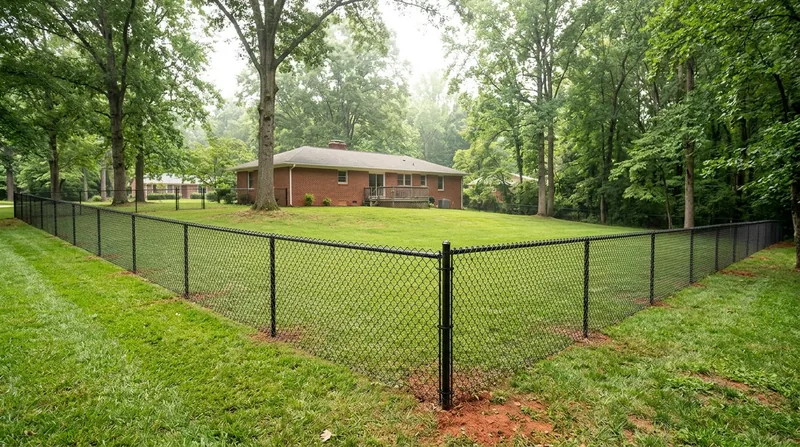




Chain link fence installation in Winston-Salem is the most practical and cost-effective way to secure a yard, kennel, or commercial lot on the rolling Piedmont terrain around Forsyth County. Our galvanized and black vinyl-coated mesh holds tight on hillside lots where settling and frost heave challenge post footings, and the gauge and tension we use withstand the weight of ice storms and the humidity that corrodes cheaper installations. Whether you need a standard 4-foot residential fence, a 6-foot privacy barrier with slats, or a commercial perimeter on red clay slopes, we install and brace chain link to last through the weather that moves through Winston-Salem. Read on to understand why gauge matters, how we set posts on slopes, and what you should expect to pay.
Why Chain Link Fence Installation Matters on Winston-Salem Slopes and Hillside Lots
Chain link is the workhorse of fencing in the Piedmont. The terrain here is cut by creeks and ravines, and half-acre suburban lots are often racked downhill or stepped across grade changes. Posts set in concrete on a slope must be plumb and deep enough to resist the lateral pressure of soil movement and frost heave in winter. Galvanized or powder-coated mesh stays straight under tension when corners are braced with anti-sag cable and the stretcher bar is pulled tight. In the humid summers and wet springs around Winston-Salem, vinyl-coated chain link resists rust and mildew better than bare galvanized, and the dark colors hide the mesh while still allowing airflow to yards and kennels.
- Galvanized steel mesh resists rust in wet clay soil and holds tension through freeze-thaw cycles that loosen cheaper installations.
- Black vinyl-coated chain link blends into wooded lots and screens views without blocking air or light the way solid fencing does.
- Properly braced corners and anti-sag cable on tall fence prevent sagging and racking as soil settles and tree roots push against the line.
- Posts set in concrete 3 feet deep on slopes resist the downhill creep that undermines tamped-only footings in red clay.
These details separate a fence that holds for fifteen years from one that leans and sags within five.
Key info: North Carolina 811 utility locates are required by law before any post holes are dug. Call 811 or go to the North Carolina One Call Center at nc811.org at least three business days before we set posts. We will not dig until the locate is complete and marked.
How We Install Chain Link Fence: From Post Setting to Tension and Bracing
Chain link installation is a sequence of steps that each affect the final result. We start by confirming your property line, running string lines, and marking post centers. On slopes, we set posts plumb using a level, not by eye, and dig post holes 3 feet deep in the red clay to get below the frost line and the active root zone. After backfilling with concrete, we let it cure before hanging the mesh. The mesh is unrolled and attached to the end posts with a stretcher bar and tension bands, then pulled tight and fastened to each intermediate post. Corners are braced with anti-sag cable to prevent the mesh from sagging under its own weight or wind load. If you want privacy slats or windscreen, those are woven into the mesh after tension is set.
- We locate and mark the fence line with your existing survey or the boundary you identify, and call 811 for utility locates before digging.
- Posts are set plumb 3 feet deep in concrete on level ground and deeper on slopes to resist frost heave and lateral soil pressure.
- Mesh is pulled tight with a stretcher bar and tension bands, then fastened to each post with hog rings or bands spaced evenly.
- Corners are braced with anti-sag cable running diagonally from the top of one post to the bottom of the next to prevent sagging and racking.
- Privacy slats or windscreen can be woven into the mesh for yards and kennels where you need sight privacy or wind break.
The result is a fence that stays plumb and tight through the seasons.
Example: A 100-foot chain link fence on a downhill lot in Clemmons requires posts set deeper on the downhill side to resist the extra pressure from the slope. Anti-sag bracing on the uphill corner and the downhill corner keeps the mesh from sagging as the fence ages. A fence without proper bracing will sag within two years in this terrain.
Chain Link Installation Methods and Gauge: What Works Best for Your Yard
| Approach | Description | Best for |
|---|---|---|
| 11-gauge galvanized | Standard residential mesh, zinc-coated steel, 2-inch diamond openings, resists rust in humid climates. | Residential yards, pet enclosures, and budget-conscious projects in Winston-Salem where durability matters more than aesthetics. |
| Black vinyl-coated 11-gauge | Galvanized steel with black PVC coating, hides the mesh, resists mildew and UV fading, costs more upfront but lasts longer in wet Piedmont climate. | Suburban yards, kennel runs, and lots where you want the fence to blend into wooded backgrounds or match landscaping. |
| 9-gauge galvanized (heavy-duty) | Thicker wire, tighter mesh, higher tensile strength, more resistant to impact and sagging on long spans or steep slopes. | Commercial perimeters, farm enclosures, and hillside lots where wind load and soil pressure are high. |
| Privacy slats or windscreen | Vinyl or fabric strips woven into existing or new mesh to block sight lines and reduce wind while maintaining airflow and drainage. | Residential yards where you want privacy without the cost and maintenance of a solid wood or vinyl fence, or kennels where visibility reduction reduces animal stress. |
Gauge refers to wire thickness: lower numbers are thicker and stronger. For most Winston-Salem residential yards, 11-gauge is sufficient. For steep slopes or commercial use, 9-gauge holds better under pressure. Mesh opening size is typically 2 inches for residential and 1.5 inches for pet containment or security.
Chain Link Fence Installation Cost in Winston-Salem: What to Expect
Chain link fence installation in Winston-Salem starts at around $16 per linear foot for standard 4-foot residential galvanized mesh with posts set 6 feet apart on level ground. The price rises with height (6-foot fence costs more than 4-foot), gauge (9-gauge costs more than 11-gauge), coating (black vinyl-coated costs more than bare galvanized), and terrain. Hillside lots, rocky soil, and poor access increase labor time and may require deeper post holes or additional bracing. A 100-foot fence on flat ground with standard gauge might run $1,600 to $2,000; the same fence on a slope with vinyl coating and privacy slats could run $2,400 to $3,200. We always get a detailed site assessment before quoting because slope, soil, and obstacles are the real cost drivers.
The best way to know what your fence will cost is to get a free estimate from us. We will walk the line, measure the distance, note the terrain, and give you a firm number based on what we see. We also recommend getting two or three estimates so you can compare not just price but what is included: some contractors charge extra for permits, bracing, or concrete, while others bundle those into the quote. See our full pricing page for more detail on what moves the cost up and down.
What to Look for When Hiring a Chain Link Fence Contractor Near Winston-Salem
Choosing the right contractor makes the difference between a fence that lasts and one that fails. Look for a contractor who is fully insured with general liability and workers' compensation coverage, and ask for a certificate of insurance before work starts. In North Carolina, fence licensing is set county by county, and projects at or above $40,000 require a licensed general contractor. Most residential fence jobs fall below that threshold, but an honest contractor will tell you upfront if your project crosses it. Ask for references from recent jobs in your area, and drive by a completed fence if you can to see how it has held up. Understand your HOA rules if you live in a master-planned community, because height, material, and color are often restricted. If your lot is in a historic district or near a protected tree, check with the city or county building department before you start, and make sure your contractor knows about those requirements.
- Verify that the contractor carries general liability and workers' compensation insurance and will provide a certificate of insurance on request.
- Ask how the contractor handles permits and utility locates, and confirm that 811 locates are called before any digging begins.
- Get a written estimate that breaks down post spacing, gauge, coating, and bracing so you know what you are paying for.
- Check references and ask to see completed fences in Winston-Salem, Kernersville, Clemmons, or Lewisville so you can assess quality and durability.
- Confirm that the contractor understands your HOA rules, deed restrictions, and any setback or height requirements in your jurisdiction.
A contractor who is clear about insurance, permits, and what is included in the price, and who listens to your needs rather than pushing the most expensive option, is worth the call. Contact us for a free estimate, and we will walk through all of these points with you before any work is scheduled.
Chain Link Fence Installation in Winston-Salem: Pricing Guide
| Service | Price | Details |
|---|---|---|
| 4-foot residential chain link, 11-gauge galvanized | Starting at $16/ft | Posts 6 feet apart set in concrete, standard mesh, level ground, no slats or bracing extras included |
| 6-foot residential or commercial, 11-gauge galvanized with anti-sag bracing | Starting at $22/ft | Posts 6 feet apart, corner bracing, concrete footings, slightly more labor and materials than 4-foot fence |
| Black vinyl-coated chain link with privacy slats | Starting at $28/ft | Coating and slats add material and weaving labor; hillside lots or poor access will increase the per-foot cost |
| 9-gauge heavy-duty or steep slope installation | On estimate | Thicker gauge, deeper post holes, additional bracing, and difficult terrain require site assessment for accurate pricing |
| Travel and 811 locates | Included | No separate call-out or mileage fee in Winston-Salem and surrounding service areas; 811 locate required by law before digging |
| Free estimate | No obligation | Response within 24 hours at (743) 270-9146; we measure, assess terrain, and provide a firm quote based on site conditions |
Indicative pricing, the exact cost depends on square footage, finish, and site access. Free personalized estimate within 24h at (743) 270-9146.


